Quick Verdict
Keeps delivers the best-studied prescription drugs for male pattern hair loss — finasteride, dutasteride, and minoxidil — through a genuinely convenient telemedicine model: 60-second assessment, licensed clinician, 48-hour delivery, from $1/day. The honest caveats: results take months (shedding may come first, peak lands at 9–12 months), 2–5% of men get side effects (typically reversible), insurance is not accepted, you must keep taking it to keep the results, and the 180-day guarantee only pays out if you meet a strict list of conditions. For men with early-to-moderate hair loss who can commit, it's one of the most sensible routes available. Our score: 4.7/5.
What Is Keeps and How Does It Work?
Keeps is a US telemedicine service for men's hair loss. The model is simple: you complete a 60-second online assessment, a licensed clinician reviews your answers and medical history, and if treatment is appropriate, your prescription ships to your door within 48 hours. Shipping is free, refills arrive automatically, virtual consultations are unlimited, and you can cancel anytime. The scale is significant: more than 1 million men have used Keeps, with over 1 million prescriptions issued.
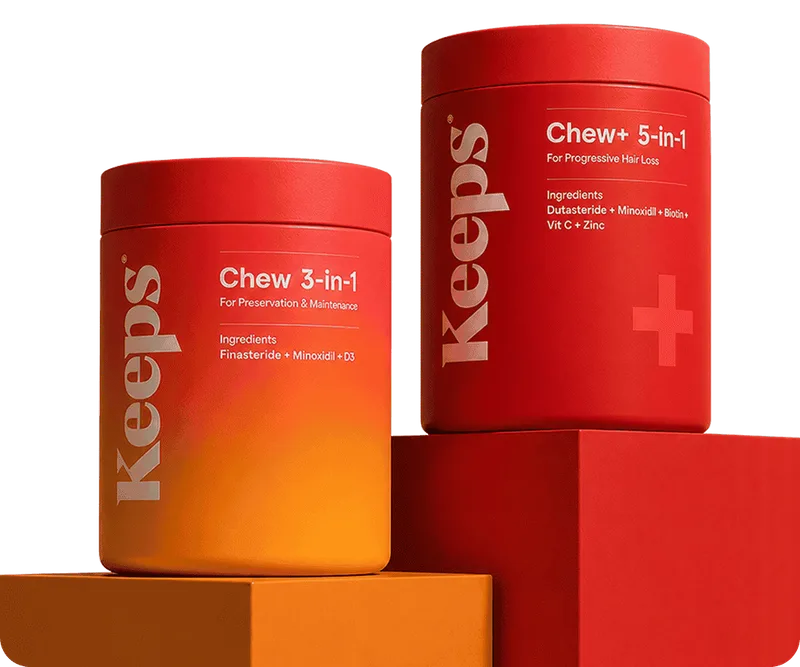
The treatments come in two families. The Daily Chew line (3-in-1 and the Chew+ 5-in-1) is an orange-citrus chewable built around a DHT blocker — finasteride or dutasteride — plus minoxidil, with support nutrients like biotin, zinc, and vitamin C. The Topical Drop line (4-in-1 and the Drop+ 11-in-1) is a scalp serum pairing the same prescription actives with tretinoin and rosemary oil. According to Keeps, its formulas combine up to 7 active ingredients into a single daily treatment.
Two things to be clear-eyed about before we go further. First, these are prescription medications — a clinician can decline to prescribe, and that's a feature, not a bug. Second, Keeps does not accept insurance: the from-$1/day pricing is out of pocket, full stop.

Active Ingredients: What's Actually in the Formulas
You won't see milligram amounts below, and that's deliberate — the prescription drugs are dosed by your clinician based on your assessment, not sold in a fixed over-the-counter strength. Here's what each component does, in plain English:
| Ingredient | Dose | What It Does |
|---|---|---|
| Finasteride | Rx — dosed by your clinician | Blocks the conversion of testosterone into DHT, the hormone that shrinks genetically sensitive follicles. The best-supported oral medication for male pattern hair loss — it fights the cause, not the symptom. |
| Dutasteride | Rx — dosed by your clinician | A more aggressive DHT blocker that inhibits both forms of the converting enzyme, where finasteride blocks one. An option a clinician may prescribe when stronger DHT suppression is warranted. |
| Minoxidil | Rx — dosed by your clinician | Stimulates blood flow to the follicle and extends the hair's active growth phase. It works the growth side of the equation while the DHT blockers work the loss side — which is why the two are so often paired. |
| Biotin, zinc, vitamin C | Included in Chew formulas | Support nutrients that contribute to normal hair keratin and follicle health. Useful supporting cast — but the prescription drugs above do the heavy lifting, and we'd be misleading you to suggest otherwise. |
| Tretinoin, rosemary oil | Included in Drop formulas | Tretinoin speeds up skin cell turnover, which can help the topical actives penetrate the scalp; rosemary oil is a botanical with early, limited evidence. Sensible additions to a serum — not the stars of the show. |
How You Actually Use It
Daily, every day — that's the whole regimen. Chew users take one chewable a day; Drop users apply the serum to the scalp as directed by their clinician. There's no cycling, no loading phase, no ritual. The refills arriving automatically is more useful than it sounds, because a treatment gap is the easiest way to undermine months of progress.
The part nobody likes hearing: these medications only work while you take them. Stop, and DHT resumes shrinking susceptible follicles — the gains fade over the following months. That makes Keeps an ongoing commitment, not a course of treatment you finish. If you have questions along the way, the unlimited virtual consultations exist precisely for that; use them rather than quietly quitting at week six because of shedding that was probably normal.
The Real Results Timeline
Months 1–3: Patience (and Maybe Shedding)
Between weeks 2 and 8, some men shed more, not less — older hairs release as follicles restart a healthier growth cycle. It's temporary and usually a sign the treatment is engaging. Visible improvement this early is rare, and quitting here is the most common mistake.

Months 4–6: First Real Changes
This is typically when the mirror starts cooperating — less scalp showing through, hair that feels denser. The changes are gradual enough that progress photos beat day-to-day judgment every time.

Month 6 and Beyond: The Payoff
Results generally peak around months 9 to 12, and men can continue improving through month 18. This is a long game — which is exactly why the 180-day guarantee window and the 6-month mark are the honest checkpoints for judging whether it's working for you.
What We Like
- Real prescription medicine — finasteride, dutasteride, and minoxidil are the best-studied actives for male pattern hair loss, not supplement-aisle hopefuls
- Genuinely low friction: 60-second assessment, licensed clinician review, delivery within 48 hours, free shipping
- From $1/day with automatic refills and no lock-in — cancel anytime
- Unlimited virtual consultations, so side-effect or progress questions go to a clinician
- Combined formulas (up to 7 active ingredients, per Keeps) replace a counter full of separate treatments
- A 180-day guarantee window that at least matches the realistic timeline for judging results
What to Watch
- These are prescription drugs: a clinician must approve you, and treatment is ongoing — stop taking it and the gains fade
- Results take months: possible shedding in weeks 2–8, visible change around months 4–6, peak only at 9–12 months
Who Keeps Is For — and Who Should Pass
A good fit if…
- You have early-to-moderate male pattern hair loss and want to act while there's more to save
- You want the proven prescription actives without booking an in-person dermatology appointment
- You can commit to daily use for at least 6–12 months and judge results by photos, not by week-three impatience
- You're comfortable paying out of pocket from $1/day, knowing insurance won't reimburse it
Skip it if…
- You expect visible results in weeks — no legitimate treatment delivers that, and Keeps is no exception
- You're looking for a women's hair-loss treatment — Keeps treats male pattern hair loss
- Your loss is long-established and the area fully smooth — these drugs revive struggling follicles; they don't resurrect ones that quit years ago
Our Verdict
4.7/5
Keeps earns its 4.7 by doing the fundamentals right: it puts genuinely evidence-backed prescription drugs behind a licensed clinician's judgment, wraps them in a low-friction telemedicine experience — 60-second assessment, 48-hour delivery, unlimited consultations, cancel anytime — and prices it from $1/day. The combined Chew and Drop formulas are a real convenience advantage over juggling separate treatments, and the scale (1M+ men, 1M+ prescriptions) says this model works for a lot of people.
Go in with the timeline understood, and Keeps is one of the most sensible ways for a US man to start treating hair loss. Go in expecting a 30-day miracle, and you'll be disappointed — by any product in this category.
Frequently Asked Questions
Does Keeps actually work?
The drugs it prescribes are the best-evidenced options for male pattern hair loss, but honesty requires a number: single-drug treatment helps roughly 60–65% of men. That's why Keeps' combined formulas — a DHT blocker plus minoxidil attacking the problem from two directions — are the more logical approach for most. Either way, judge results at month 6, not week 6.
What are the side effects of Keeps treatments?
About 2–5% of men report side effects, and they're typically reversible after stopping or adjusting treatment. The ones men worry about most — reduced libido and other sexual side effects — are associated with the oral DHT blockers and affect a small minority. If anything feels off, use the unlimited virtual consultations; adjusting the plan is a clinician's call.
Does Keeps take insurance?
No. Keeps does not accept insurance, so treatment is entirely out of pocket. The counterweight is the pricing — plans start from $1/day with free shipping included — but if insurance coverage is a requirement for you, this isn't the right service.
How does the 180-day money-back guarantee work?
You get your money back only if you meet every condition: you're a new patient, you purchased 4 new products, you used the treatment continuously for the full 180 days, you submitted the required before-and-after photos, and you filed your claim within 30 days after the 180 days ended. Shipping and consultation fees are excluded from the refund. It's a genuine backstop for disciplined users — and worthless to anyone who skips a condition.
What happens if I stop taking the treatment?
The gains gradually reverse. Finasteride and dutasteride only suppress DHT while they're in your system, and minoxidil only supports growth while you're applying or taking it — so within months of stopping, hair loss resumes its old course. Treat Keeps as an ongoing subscription to your results, not a one-time fix.
Should I choose the Daily Chew or the Topical Drop?
It's ultimately a clinical decision — your prescribing clinician recommends a formula based on your assessment. As a practical matter, the Chew suits men who want the simplest possible routine (one chewable a day), while the Drop suits men who prefer treating the scalp directly rather than taking an oral dose. Both are built on the same prescription actives.